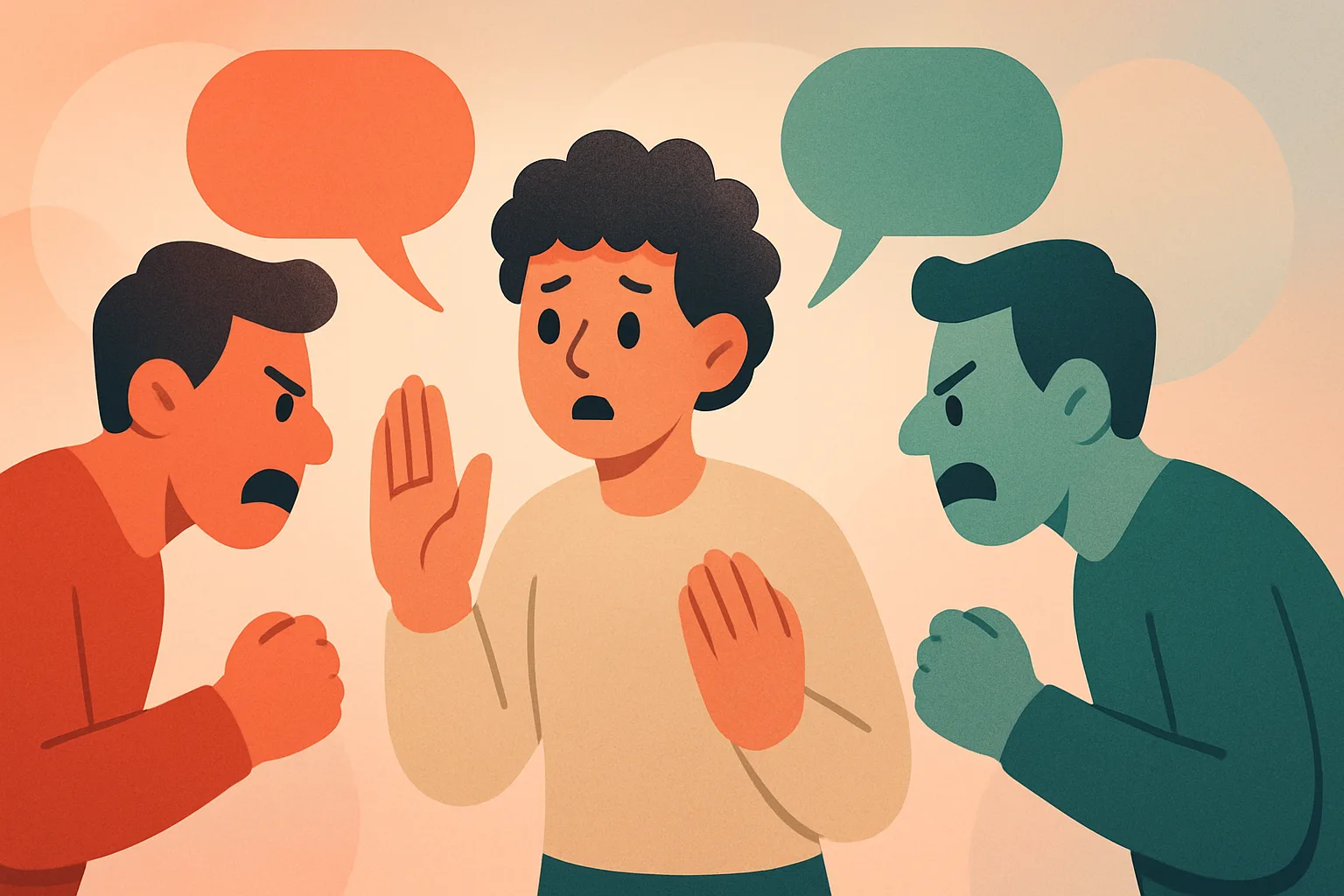
Why Text Arguments Escalate So Fast
Text removes every moderating signal that in-person conflict has. No tone of voice. No facial expression. No ability to see that the other person is crying, or nervous, or actually agreeing with you but struggling to find the words. What is left is just words — and words stripped of context default to their harshest possible reading.
Add to this the asynchronous nature of text: you cannot interrupt, you cannot hear the hesitation before a reply, you cannot tell whether a long pause means anger or just that someone is busy. Every silence becomes interpretable. Every short reply becomes a signal. And because you cannot see the other person's face, you fill in the gaps with your worst assumptions.
Text arguments also lack the natural rhythm of in-person conflict. In person, there are pauses. There is body language that signals "I am done talking, your turn." There is the social pressure of shared physical space that prevents people from walking away mid-sentence. Text has none of that. Arguments can stretch over hours or days, with each person re-reading the exchange and building resentment between replies.
The Escalation Patterns to Avoid
Sending multiple messages before a reply.
Each additional message raises the emotional stakes. The other person returns to three or four messages waiting — already feeling outnumbered before they have typed a word. It feels like being yelled at. Even if your individual messages are reasonable, the volume creates pressure.
If you catch yourself typing a second message before they have replied to the first, stop. Wait. Give them space to respond. The urge to send more is usually anxiety, not necessity.
Reacting immediately.
Text allows — and rewards — pause. The message is not going anywhere. Reading something that makes you angry and replying within seconds almost never produces a good outcome. You are reacting from emotion, not thought. And that reaction is permanent. You cannot take it back. You can apologize later, but the words have already landed.
If a message makes you angry, do not reply immediately. Wait at least ten minutes. Longer if possible. The intensity will fade. And when you do reply, you will be responding to what they actually said, not to what your anger told you they meant.

Matching aggression.
If the other person's message feels hostile, meeting it with equal hostility creates a spiral. Each exchange raises the temperature by a degree. Before you know it, you are both saying things you do not mean, and the original issue is buried under layers of hurt.
When someone sends you a hostile message, your instinct is to defend yourself by attacking back. Resist that instinct. Responding with calm when they are escalating is one of the most powerful de-escalation tools you have. It breaks the cycle.
Bringing in past grievances.
Text conflicts often expand rapidly to cover everything unresolved. "This is just like when you..." turns a specific disagreement into a general verdict on the relationship. Now you are not arguing about the thing that happened today. You are arguing about everything that has ever happened. And that is unwinnable.
Stay specific. Stay in the present. If past issues are relevant, they deserve their own conversation — not to be weaponized in the middle of a different argument.
Using absolutes.
"You always..." "You never..." These words are almost never true, and they trigger defensiveness immediately. The other person stops listening to your point and starts mentally listing exceptions to prove you wrong.
Replace absolutes with specifics. "You did not reply to my message yesterday" is a fact. "You never reply to my messages" is an accusation. One invites discussion. The other invites a fight.
De-escalation Techniques That Work Over Text
Name what you are feeling, not what they did.
"I felt dismissed when I read that" is harder to argue with than "You were dismissive." The first is a report of your internal experience. The second is an accusation about their behavior. One invites empathy. The other invites defense.
This is the difference between "I feel hurt" and "You hurt me." Both communicate pain. But one centers your experience, and the other centers blame. And blame escalates. Experience invites understanding.
Ask a question instead of making a statement.
"Can you help me understand what you meant by that?" lowers temperature. It signals that you are trying to understand, not win. It gives the other person a chance to clarify or soften what they said. And often, once they explain, you realize you misread their intent.
Compare that to: "I cannot believe you said that." One opens conversation. The other closes it.
Suggest a call.
If a text conversation is going in circles, "Can we talk about this on the phone?" is almost always the right move. Some conflicts genuinely cannot be resolved in text. The medium itself is too limiting. Vocal tone, pacing, and the ability to interrupt and clarify in real time are essential for complex emotional conflict.
Suggesting a call is not escalating. It is not giving up. It is choosing the right tool for the job. If the other person refuses, that is information too. But most people will agree, because most people also feel the limitations of text in conflict.
Use explicit softeners.
"I am not trying to attack you" or "I think we are saying the same thing differently" — these verbal signals are lost in text and need to be stated explicitly. In person, your tone of voice does this work. In text, you have to name it.
Softeners do not make you weak. They make you clear. They help the other person hear your actual intent instead of filling in the gaps with assumptions.
Acknowledge their point before making yours.
"I hear what you are saying" or "I understand why you feel that way" before you state your own perspective signals that you are not just waiting for your turn to talk. You are actually listening. And that makes them more likely to listen to you in return.
This does not mean you have to agree. It just means you are acknowledging that their perspective is real and valid, even if it is not the same as yours.
What Not to Do
Do not use sarcasm. Sarcasm is almost impossible to read correctly in text. What feels like lighthearted teasing to you can read as cruelty to them. If you are in the middle of a conflict, sarcasm will make it worse.
Do not leave someone on read during a conflict. If you need time before replying, say so. "I need some time to think about this. I will get back to you later today." Silence during conflict reads as punishment or dismissal, and it escalates anxiety.
Do not screenshot the conversation and send it to someone else while the conflict is unresolved. This feels like a betrayal. If you need to vent, talk to someone. But do not show them the messages. That turns your conflict into a public performance, and it damages trust permanently.
When to Stop Texting Entirely
If the conversation has gone through more than three or four exchanges without resolution, the medium is the problem. Text is not the right tool for complex emotional conflict. Switching to voice or video is not giving up — it is choosing the right tool.
Signs it is time to stop texting:
- The conversation is going in circles
- Either person is becoming increasingly frustrated
- Misunderstandings are piling up faster than you can clarify them
- The tone is escalating despite both people trying to stay calm
- You are both re-reading old messages and building resentment
At that point, text is making things worse, not better. Suggest a call. Suggest meeting in person. Suggest taking a break and coming back to it later. But stop texting.
Check Your Tone Before You Send
EmoScan reads the emotional temperature of a message — useful for checking your own reply before sending. Paste your draft and see whether it reads as de-escalating or likely to inflame. You will see:
- Whether your message reads as calm or aggressive
- Whether you are using accusatory language
- Whether your tone matches your intent
Sometimes what feels like a reasonable response to you reads as an attack to the other person. Catching that before you hit send can prevent an entire spiral.
Final Thoughts
Text is not a good medium for conflict. It strips away the signals that help us regulate emotion and interpret intent. But sometimes conflict happens over text anyway — because that is where the conversation was already happening, or because in-person is not an option.
When that happens, slow down. Pause before replying. Name your feelings instead of accusing. Ask questions instead of making statements. And know when to stop texting and switch to voice.
The goal is not to win the argument. The goal is to resolve the issue without damaging the relationship. And that requires more care in text than it does in person, because the medium itself is working against you.