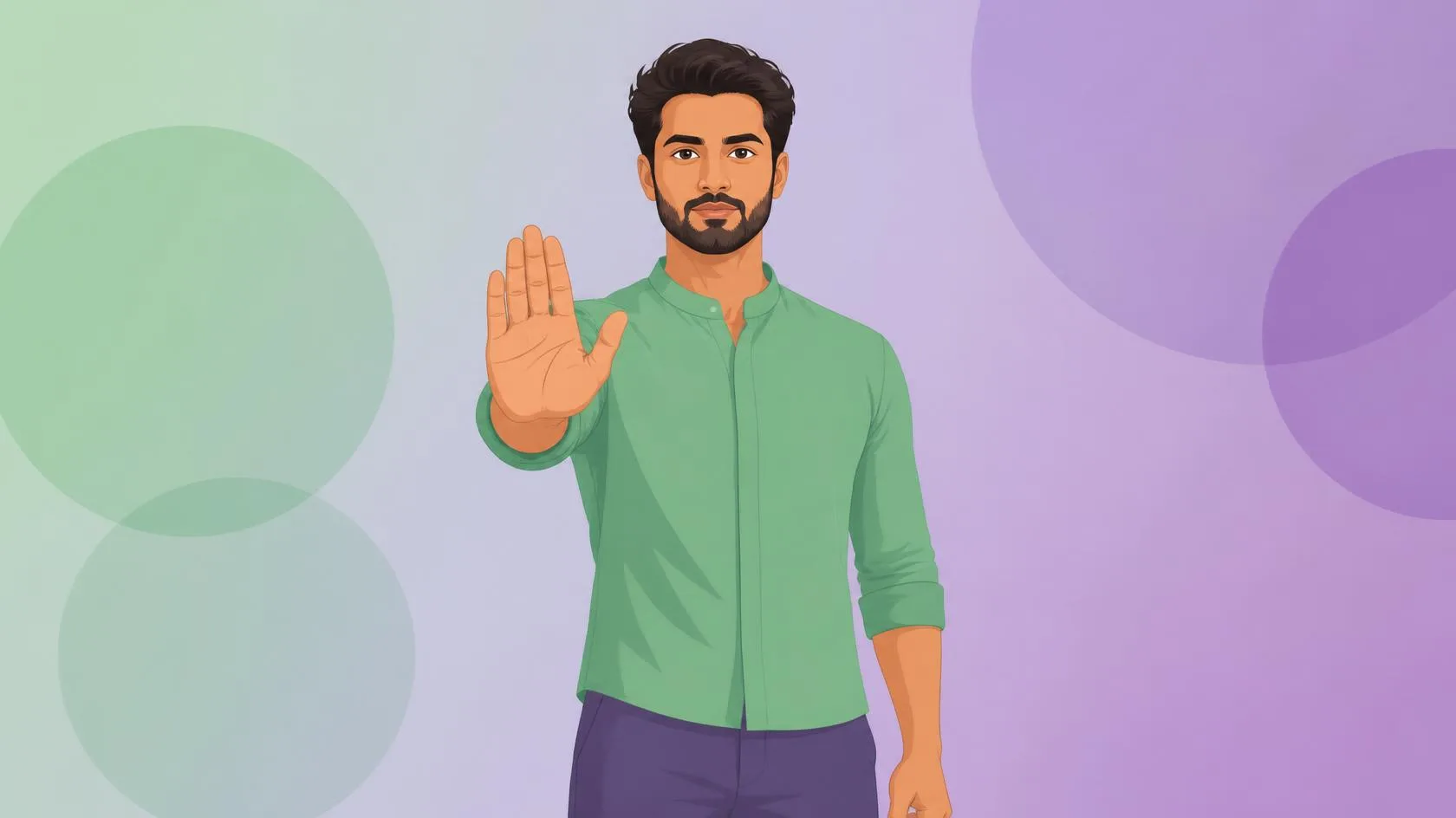
Saying no over text has a specific difficulty: you have time to think, which means time to second-guess and soften a clear no into a maybe that creates problems later. You draft the message. You reread it. You add qualifiers. You apologize three times. And by the time you hit send, your no has become so hedged that the other person thinks they can still change your mind.
Saying no is hard enough in person. Over text, the guilt tends to linger longer because you cannot see the other person's reaction. You do not know if they are hurt, annoyed, or completely fine. So you sit with the discomfort alone, replaying the message, wondering if you were too harsh or not clear enough.
Here is how to decline gracefully, firmly, and without the aftermath of guilt.
How to Say No Clearly
Be direct without being cold.
"I will not be able to make it" is better than "I might not be able to make it." The first is a clear no. The second is a maybe, which invites follow-up, negotiation, or hope that you will change your mind. Directness is not rude. It is respectful. It tells the other person where you stand so they can plan accordingly.
Examples:
- "I am not going to be able to make it, but thank you for thinking of me."
- "I cannot commit to this right now."
- "That does not work for me, but I appreciate the invite."
Notice the structure: clear no + warmth. You are declining the request, not rejecting the person.
You do not owe a detailed explanation.
"I cannot this time" is a complete answer. You do not need to justify your no with a list of reasons. In fact, elaborate explanations often backfire because they invite negotiation. If you say "I cannot come because I have a thing at 7," the other person might suggest you come at 6. If you say "I am just too tired," they might tell you it will be low-key and you can leave early.
Your no does not need to be defended. It just needs to be stated.
That said, context matters. With close friends or important relationships, a brief explanation shows you care: "I would love to, but I am at capacity this week." With casual acquaintances or people you do not know well, less explanation is fine.

Check how your message sounds
Paste any message or email and see whether it reads as warm, cold, rude or passive-aggressive before you send it.
Try Check Message →Acknowledge the request warmly before declining.
"That sounds great — I am not going to be able to join this time, but I hope it is wonderful."
This structure does two things. It shows you heard them and appreciate the invite, and it declines clearly. The warmth softens the no without undermining it. You are not saying maybe. You are saying no, kindly.
Examples:
- "I really appreciate you thinking of me. I am not going to be able to make it work this time."
- "That sounds like so much fun. I cannot swing it, but I hope you have a great time."
- "Thank you for asking. I am going to have to pass, but I am glad you reached out."
Offer an alternative if you genuinely want to.
If you actually want to see this person but cannot make the specific event, say so. This transforms a no into a redirect.
"I cannot do Friday, but would love to grab coffee next week if you are free."
But only offer an alternative if you mean it. Do not say "let's do it another time" if you have no intention of following through. That is worse than just declining. It creates false hope and makes you seem flaky later when you do not follow up.
Do not apologize excessively.
One apology is appropriate. Three signals that you feel guilty about having needs.
Compare:
- "I am so sorry, I really wish I could but I just cannot, I feel terrible about it, I am sorry."
- "I am sorry I cannot make it this time. I hope it is great."
The first one centers your guilt. The second one centers the decline and moves on. You are allowed to say no without performing remorse.
Why Saying No Feels So Hard Over Text
You cannot see their reaction. In person, you can gauge how they take it. Over text, you send the message and then sit with the uncertainty. Did they understand? Are they hurt? Are they annoyed? You have no idea, and your brain fills the silence with worst-case scenarios.
Text feels permanent. Once you send it, it is there. You cannot soften it with tone or body language. You cannot immediately follow up with "but I really do want to see you soon." The message just sits there, and you worry it came across harsher than you meant.
Saying no feels like rejection. You know you are just declining an invite, but it feels like you are rejecting the person. And over text, without the warmth of your voice or a hug to soften it, the no can feel colder than it would in person.
Common Mistakes That Make Saying No Harder
Hedging your no.
"I am not sure I can make it" or "I will try" when you already know the answer is no. This drags it out. The other person thinks there is hope, and you have to decline again later. Just say no the first time.
Over-explaining to soften the blow.
Long paragraphs about why you cannot make it, listing every obligation and stressor. This makes it seem like you are trying to justify your no, which implies you feel guilty about it. Keep it short. Your no is valid without a thesis defense.
Saying yes when you mean no.
This is the worst option. You avoid the discomfort of saying no in the moment, but you create resentment later when you have to show up to something you did not want to do. Or worse, you cancel last-minute, which damages trust more than just declining upfront would have.
Blaming external factors instead of owning your choice.
"My partner does not want me to go" or "My boss is making me work late." Maybe those things are true, but framing it that way makes it sound like you would say yes if only circumstances were different. Own your no. "I am not going to make it" is enough.
Templates for Saying No
Here are a few ready-to-use templates for different situations:
Declining an invite:
"Thank you so much for the invite. I am not going to be able to make it, but I hope you have a great time."
Declining a favor:
"I appreciate you thinking of me. I am not going to be able to help with this, but I hope you find someone who can."
Declining with an alternative:
"I cannot do this weekend, but I would love to catch up next week if you are free."
Declining without explanation:
"I am not going to be able to make that work. Thanks for understanding."
Declining something you have already committed to:
"I know I said yes, but I need to back out. I am sorry for the inconvenience."
How to Handle Pushback
Sometimes people do not take no gracefully. They ask why. They try to negotiate. They make you feel guilty for declining.
Here is how to hold your boundary:
Do not re-explain. If you already gave a reason and they are pushing back, repeating yourself will not help. Just restate your no: "I understand, but I am not going to be able to make it work."
Do not get defensive. You do not need to justify your no or prove it is valid. "I hear you, but my answer is still no."
End the conversation if it continues. "I have given you my answer. I hope you understand." Then stop responding. You do not owe someone endless negotiation just because they will not accept your no.
The Guilt After Saying No
Even when you say no well, the guilt might linger. You worry you let someone down. You replay the message. You wonder if you should have just said yes.
Here is the truth: the guilt after saying no is the cost of self-respect. You cannot protect everyone else's feelings without sacrificing your own needs. And if you say yes every time because you cannot tolerate the guilt of saying no, you will end up exhausted, overcommitted, and resentful.
The guilt fades when you practice saying no clearly enough that it stops feeling like a transgression. It is not a transgression. It is a boundary. And boundaries are how healthy relationships work.
Final Thoughts
Saying no over text does not have to be agonizing. Be direct. Be warm. Do not over-explain. Do not apologize excessively. And do not let guilt pressure you into a yes you will regret later.
Your no is valid. You do not need permission to decline. And the people who matter will respect your boundaries, even when your answer is not what they hoped for.