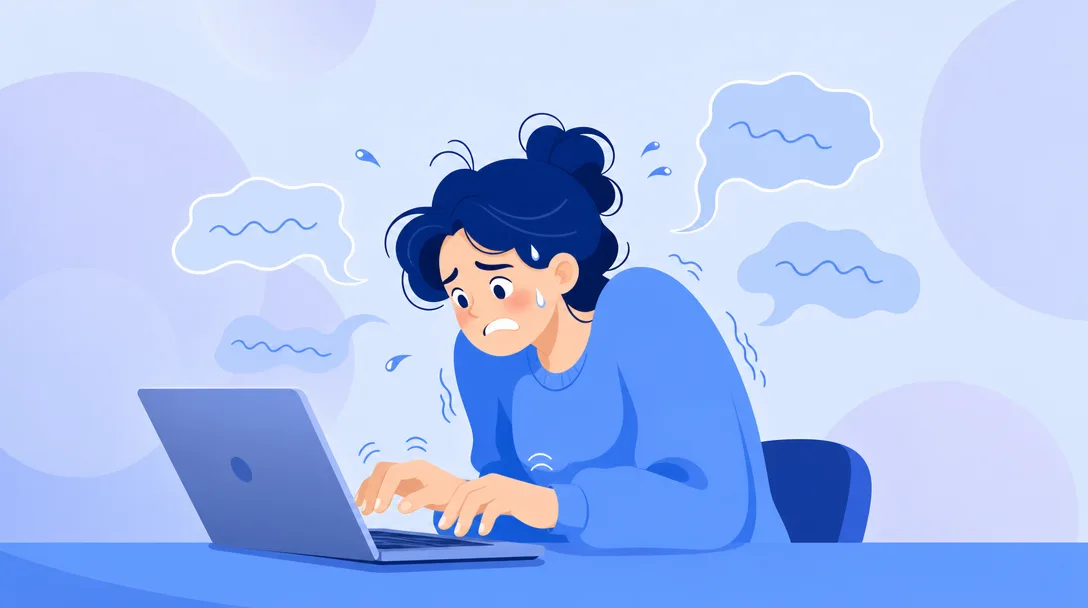
How Anxiety Shows Up in Writing
Anxiety affects communication in predictable ways. Whether it is social anxiety, workplace anxiety, or relationship anxiety, the same psychological mechanisms produce the same linguistic patterns. And because text lacks the regulating effect of real-time social feedback — where you can see someone nod, smile, or look confused and adjust accordingly — anxious communication often intensifies in writing.
You cannot see the other person's reaction. You cannot gauge whether they understood. You cannot correct a misunderstanding in real time. So anxiety fills that gap with worst-case scenarios and preemptive protection. And that shows up in how you write.
Signs of Anxiety in Your Own Messages
Over-qualifying everything.
"I might be wrong, but maybe we could possibly consider..." Anxiety adds hedges upon hedges to soften the potential for rejection or criticism. Every statement gets insulated with "I think," "maybe," "possibly," "just," "sort of." The message becomes so soft it almost disappears.
This comes from a fear of being wrong or being seen as too assertive. But the irony is that over-qualifying makes you sound less confident and less credible, which increases the likelihood of the rejection you were trying to avoid.
Apologizing preemptively.
"Sorry to bother you," "sorry for the long message," "sorry if this is a stupid question" — before the actual message begins. The apology is a shield against anticipated judgment. It says: please do not be annoyed with me. I know I am inconveniencing you. I will make myself small so you do not reject me.
But excessive apologizing has the opposite effect. It makes the recipient uncomfortable. It puts them in the position of having to reassure you, which adds emotional labor to a simple interaction.
Re-reading before sending.
Once is editing. Twice is caution. Five times, reading it from the recipient's perspective, imagining every possible way it could be misread, changing one word and then changing it back — that is anxiety at work.
Anxious writers obsess over tone. Could this sound rude? Could this sound needy? Could this be misinterpreted? The message gets rewritten multiple times before it goes out, and even then, you are not sure it is right.
The follow-up message.
Sending a message and then immediately sending a clarifying one because the first one might have sounded wrong. "Wait, I did not mean it like that." "To clarify..." "Just to be clear..." Then wondering if the clarification made it worse. Then resisting the urge to send a third message.
This is anxiety's editing process happening after the send button, which defeats the purpose of editing beforehand.
Waiting for read receipts.
Not just noticing them — interpreting them. "They read it 3 hours ago and have not replied. What does that mean?" Anxiety turns read receipts into evidence. Evidence of disinterest. Evidence of anger. Evidence that you said something wrong.
Non-anxious people see a read receipt and think: they are busy. Anxious people see a read receipt and think: they are mad at me.

Overthinking every emoji.
Does one exclamation point sound too enthusiastic? Does no exclamation point sound cold? Should I add a smiley face? Will that seem unprofessional? Anxiety turns punctuation into high-stakes decisions.
Deleting and rewriting entire messages.
You type something out. You delete it. You type something else. You delete that too. You go back to the first version. You tweak it. You delete it again. By the time you finally send something, you have written and discarded five different versions.
Avoiding sending the message at all.
The ultimate anxiety move: not sending the message because you cannot get it right. You draft it, obsess over it, and then just... do not send it. You tell yourself you will send it later. Later never comes. The message sits in drafts forever.
Signs of Anxiety in Someone Else's Messages
Excessive explanation.
Far more context than the situation requires. Anxious writers often preemptively answer objections that have not been raised, covering every angle to prevent misunderstanding. A simple request becomes three paragraphs of justification.
Example: Instead of "Can we reschedule our meeting to Thursday?" you get: "I know we have a meeting scheduled for Wednesday, and I really value our time together, but something came up that I cannot move, and I feel terrible about asking, but would it be possible to move it to Thursday? I completely understand if that does not work for you, and I am happy to work around your schedule."
The anxiety is in the over-explanation. They are not just asking. They are defending the ask before you have even responded.
Unusual formality.
Suddenly writing in full sentences with proper punctuation to someone they normally text casually. Anxiety can shift register upward as a form of self-protection. If I am extra polite and formal, maybe I will not be rejected.
This shift is noticeable. If someone usually texts you "hey can u send that file" and suddenly sends "Hello, I hope this message finds you well. Would it be possible for you to send me the file when you have a moment? Thank you very much." — something has made them anxious.
Delayed replies followed by long messages.
The delay was spent composing and recomposing. The long message is the result of multiple drafts compressed into one. Anxious people often take longer to reply not because they do not care, but because they care too much. They are trying to get it perfect.
Checking in repeatedly.
"Did you get my message?" "Just wanted to make sure this came through." "Let me know when you have a chance." Multiple follow-ups before a reply has had time to arrive. This is anxiety seeking reassurance. The silence is unbearable, so they fill it.
Self-deprecating language.
"This is probably a dumb question, but..." "I know you are busy and probably do not care, but..." "I am probably overthinking this, but..." Anxiety preemptively minimizes the self to avoid criticism.
Why Anxiety Shows Up More in Text Than in Person
In face-to-face conversation, social cues regulate anxiety. You see the other person smile, and you know they are not upset. You hear their warm tone, and you relax. The feedback loop is immediate.
In text, that loop is broken. You send a message and then... nothing. You do not know if they read it. You do not know how they reacted. You do not know if you said something wrong. Anxiety fills that silence with catastrophic interpretations.
And because there is no real-time correction, anxious communication compounds. You send one over-explained message. You worry it was too much. You send a follow-up. Now you have sent two anxious messages, which makes you more anxious. The spiral continues.
Why This Matters
Recognizing anxiety in communication — your own or someone else's — changes how you respond.
If you recognize it in yourself: You can start catching it. When you notice yourself rewriting a message for the fifth time, stop. Send it. It is probably fine. When you notice yourself apologizing before you have even made a request, delete the apology. Just make the request. The anxiety is lying to you about how bad it is.
If you recognize it in someone else: You can respond with reassurance instead of matching their energy. An over-explained message does not need a detailed rebuttal. It needs: "No problem, Thursday works." A preemptive apology does not need acceptance. It needs: "No need to apologize — happy to help."
Understanding the emotional driver behind a message makes your response far more effective. If you respond to the anxiety instead of the content, you de-escalate. If you respond only to the content, you might miss what the person actually needs: reassurance that they are not a burden, that they are not annoying, that you are not mad at them.
How to Reduce Anxiety in Your Own Messages
Set a rewrite limit. Allow yourself two drafts. After that, send it. You are not making it better. You are just feeding the anxiety.
Remove one apology per message. If you wrote "sorry" three times, delete two of them. See how it feels. Probably fine.
Turn off read receipts. If seeing that someone read your message and did not reply immediately causes you distress, turn the feature off. You do not need that information.
Use a tone checker. EmoScan identifies anxiety as one of its core emotional dimensions. Paste your message before you send it and see whether anxiety is driving the tone, and how strong it reads. Sometimes seeing objectively that your message does not sound as anxious as you feel helps you send it.
Practice sending "good enough" messages. Not perfect. Not optimized. Just good enough. Over time, this builds tolerance for imperfection and reduces the compulsion to over-edit.
Final Thoughts
Anxiety in text messages is not a character flaw. It is a nervous system trying to protect you from perceived social threat. But the protection often backfires. Over-apologizing makes people uncomfortable. Over-explaining makes you seem unsure. Excessive hedging makes you less credible.
The goal is not to eliminate anxiety. The goal is to recognize it and decide whether to act on it. Sometimes the anxious impulse is useful. Most of the time, it is not. And learning to tell the difference — and to send the message anyway — is how you stop letting anxiety control your communication.